mioceneのTwitterイラスト検索結果。 147 件中 5ページ目


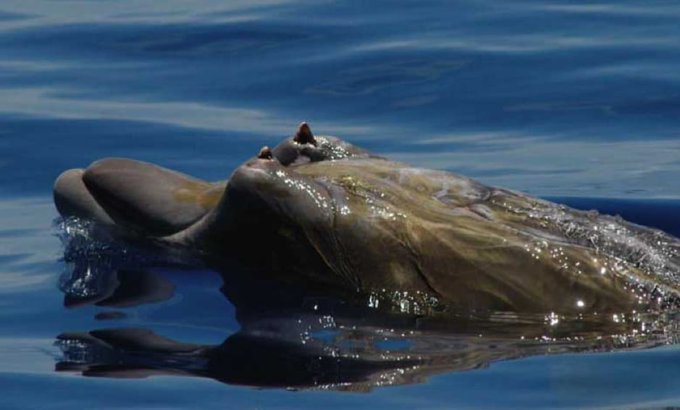
For #FossilFriday some news of Master student research. He may have some beaked #whales among the studied specimens 🐬🐬🐬! These strange #Dolphins possess tusks. I am wondering how they looked like during the middle Miocene 🤔Very nice work on the ear, very intriguing animals.


Dragon with headgear borrowed from the Miocene giraffe relative Prolibytherium, because why not. About a dozen different brushes used, because I got new ones and I’m trying to learn to use them.


Synthetoceras or the 'horned horse' from the Miocene epoch. Only males had the strange horn on their nose.
(Credit: https://t.co/Ajt2VOgTNb)


Another terror bird, Kelenken guillermoi, has the largest skull (~70 cm) of any known bird. From the Middle Miocene of Argentina.

This is Brontornis burmeisteri, the "thunder bird" from Early Miocene South America. One of the so-called terror birds...


Protoceras celer (first horns) from the Oligocene to the Early Miocene 33.3—16 MYA, existing for approximately 17 MY. Discovered by Othniel Charles Marsh in 1891, from North America. Classifies as Artiodactyla, Protoceratidae, Protoceratinae. Illustration by Joschua Knuppe. 🤓🐉


@paleorangers #PRDinovember2020 Day 28: Tiny terror: Procariama! Here's Procariama spooking a Miocene viscacha for its' own amusement more than anything.


@JCRev4 @king_tyranno Oh yes, there was actually a dinosaur rhino. I present you Rhinosaurus magnus. An extinct genus of abelitheriid rhino that existed from the early oligocene to Early Miocene of central Davidpeteropia. It was exclusively a carnivore, a unique trait within perissodactyla.


Today I present you an extinct Rhino from the Early Miocene of North America. Meet Menoceras, a pig sized rhino showing interesting sexual dimorphism. Male Menoceras sported two horns side by side at the tip of the nose, whereas the females were hornless.
#paleontology


I present to you a Giraffoid, Specifically a Climacoceratid Artiodactyl (even toed ungulate) from the Early Miocene of North Africa and Pakistan. Meet Prolibytherium (as i like to call it, Butterfly Giraffoid). A Ruminant displaying dramatic sexual dimorphism.
#paleontology


It's #InternationalSnowLeopardDay! Let's check out one of the oldest big cat fossils known - this skull from Panthera blytheae, an early extinct big cat.
This fossil was found in the Tibetan Himalaya Range and is estimated to be from the Late Miocene–Early Pliocene (~6 MYA)!


Another post of today. Here I would like to talk about a member of the only extinct lineage of marine mammals (Desmostylia). Meet Neoparadoxia from the Miocene of North America, like most of its relatives it might have been fully aquatic.
https://t.co/DCokTld5MD
#paleontology


Deep-water sand-fairway mapping as a tool for #tectonic restoration: decoding #Miocene central Mediterranean #palaeogeography using the Numidian turbidites of southern Italy
#OpenAccess Journal of the @geolsoc
@CGGcompany
https://t.co/BN54JMufeA


There once existed a Palaeomerycid (extinct family of ruminants closely related to Giraffids) named after one of the most iconic Star Wars characters, Padme Amidala. Meet Xenokeryx amidalae, known from the Mid-Miocene of Spain.
#paleontology
Art credit (Nix illustrations)


Iranotherium morgani, an extinct genus of Rhino from the late Miocene, and a relative of Elasmotherium. The only known rhinoceros with rugosity on each zygomatic arch of the male individual. As evident in this individual from the Late miocene of Linxia basin.
#paleontology


@EmperorATsamaku @AJMasterSith @irequesthugs @PurpleForever19 @ivorymoonwolf And Aepycamelus, a giraffe-like camel, and an extinct genus of camelids that lived during the Miocene 20.6–4.9 million years ago, existing for about 15.7 million years


The new fossil sawshark 🦈 Pristiophorus humboldti from the early Miocene of Chile with sea snails (Olivancillaria sp.) and crustaceans 🦀(Trichopeltarion sp.) that were found in the same area. Illustration made by Rossana Rojas. #illustration #paleontology #sharks


did i draw canon bisexual kitty pryde instead of paying attention in class? maybe. but we can all agree this is more important than the miocene


The skull of Gompy, nickname from Gomphotherium productum, was first discovered and excavated in 1988 near Santa Cruz, NM by Jack Whetstone. This Miocene elephant was estimated to be a young female and she had both upper and lower tusks! Image credit Pedro Toledo.


Long-necked Camel (Aepycamelus giraffinus)
Meaning: "high camel"
Height: 3 m(9.8 ft)
Lived: Miocene North America
Diet: herbivore
Family: camelidae
Named: 1909