
ARCHIVED NASA Exoplanetsさんのイラストまとめ
@NASAExoplanetsFollow @NASAExoplanetsさんをフォローする
フォロー数:95 フォロワー数:1384442


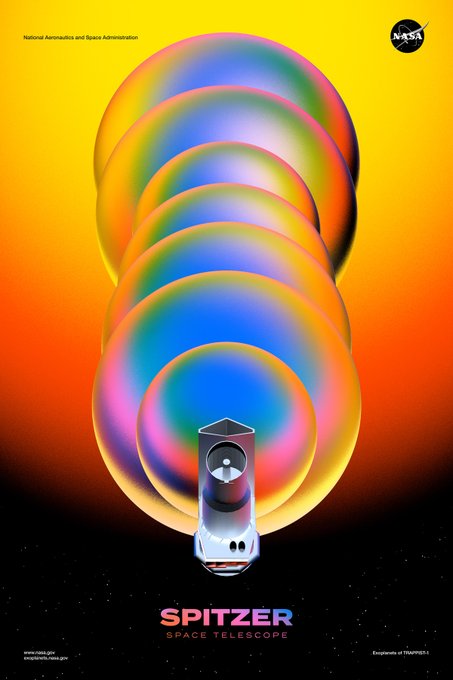

Science is a shared endeavor. And the tools that we use, like space telescopes, are also used together to build on what we know. Think of them like science superstars! And every superstar🤩 deserves a poster…
We'll release a new one tomorrow! https://t.co/fJvd5gJmk7


So far, we've released three posters celebrating @NASA space telescopes that study worlds beyond our solar system -- exoplanets. We'll launch🚀a new poster next week! Any guesses?🤔Meanwhile, collect them all! https://t.co/fJvd5gJmk7

Meet TrEs-2b, the planet of eternal night. This alien world is less reflective than coal. Some scientists think an eerie deep red glow would emanate from its burning atmosphere – the air of this planet is as hot as lava. https://t.co/pgJJvwNXNX

“The kinds of planets that could be [considered] Earth-like may be very different from modern Earth.” Suppose life elsewhere is not “life as we know it.” Would we recognize life as we don’t know it?
It comes down to one big question: Are we alone? https://t.co/r89tMkExEP

Our galaxy contains billions of stars, our Sun among them. If each of those stars has not just one planet, but, like ours, a whole system, then the number of exoplanets is truly astronomical: into the trillions.
#MondayMotivation: Find your world.
https://t.co/XaT8k0WsHU
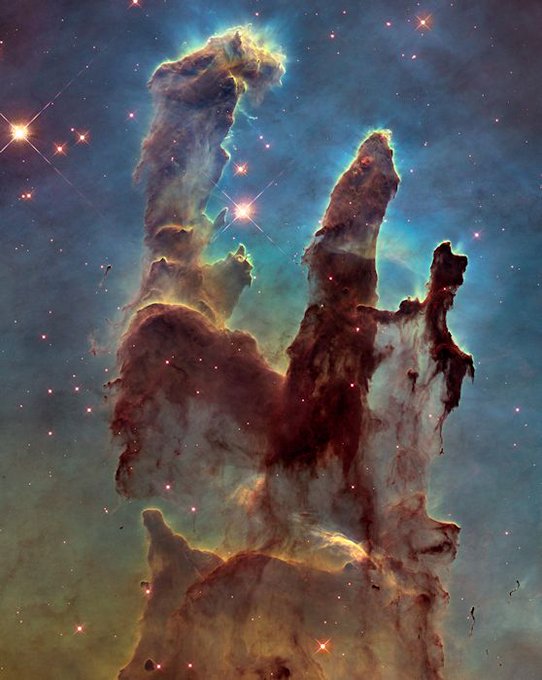
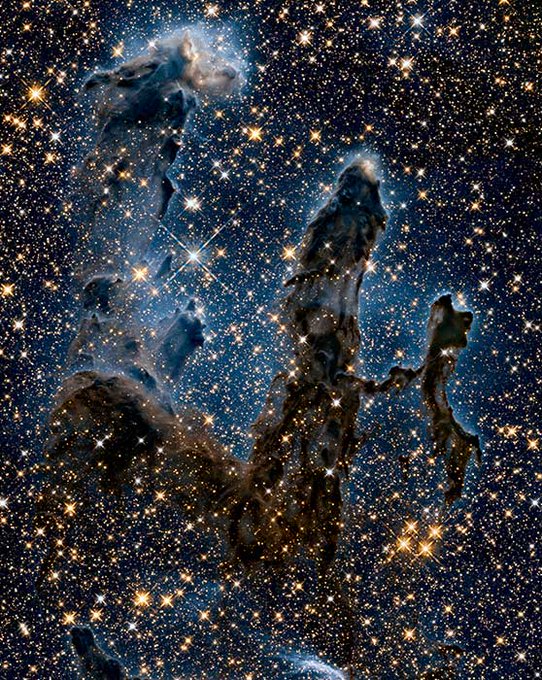
Looking at the Pillars of Creation in visible light (left) & infrared (right) shows how different views expand what we see. Infrared isn't blocked by the clouds of dust & gas that form the pillars, revealing stars within & beyond.
@NASAWebb will explore the cosmos in infrared.

57 light-years away, a giant pink exoplanet orbits a star like our Sun, but bigger. GJ 504b is one of the lowest-mass planets we know of: If we had a big enough bathtub, it would float.
Explore it & other Strange New Worlds: https://t.co/jYjOEE0lyq


31.9 light-years away, an M dwarf called AU Microscopii – AU Mic for short – is actively flaring with the energy of a fiery young star. Scientists just discovered a planet bathed in these blasts. Get the poster based on real science: https://t.co/5yQFBVhm2O
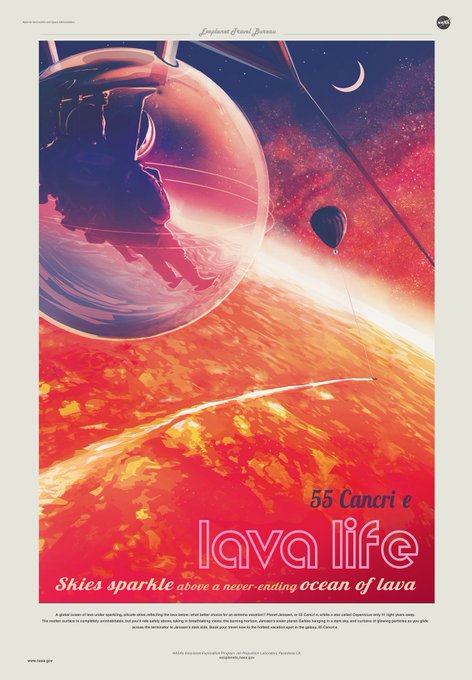

41 light-years from Earth🌎 a global ocean of lava🌋 simmers under a sparkling sky on the exoplanet 55 Cancri e. How would YOU envision this planet beyond our solar system? #ColorWithNASA and show us!
#NASAatHome has something for everyone. Downloads: https://t.co/aZFXYgnrEp

We use the phrase "habitable zone" a lot. Does that mean inhabited? Nope! It means a planet is at a distance from its star where liquid water *could* exist on its surface. It's a distinction we can use to tell which planets deserve more study👀
https://t.co/TjwPvyDPcz