Old English Wordhordさんのイラストまとめ
@OEWordhordFollow @OEWordhordさんをフォローする
フォロー数:391 フォロワー数:26258


#OldEnglish #WOTD: feþer, f.n: feather; quill, pen. (FEH-ther / ˈfɛ-θɛr) Image: Stork in Gerald of Wales’s Topography of Ireland; N England (Lincoln?), c. 1196-c.1223; @BLMedieval Royal 13 B VIII, f. 9v.

#OldEnglish #WOTD: belle, f.n: bell. (BELL-uh / ˈbɛl-lə) Image: Gospel Lectionary; France (Paris), late 13th century; @BLMedieval Add MS 17341, f. 6v.

#OldEnglish #WOTD: mete-seax, n.n: a knife used in cutting food, dagger. (MEH-tuh-SEH-ahks / ˈmɛ-tə-ˌsɛaks) Image: Bede's Prose Life of St Cuthbert; England (Durham), 12th century; @BLMedieval Yates Thompson MS 26, f. 28v.

#OldEnglish #WOTD: ā-melcan, str.v: to milk. (ah-MELL-kahn / a-ˈmɛl-kan) Image: Bestiary; S England (Salisbury?), 2nd quarter of 13th century; @BLMedieval Harley 4751, f. 23r.

#OldEnglish #WOTD: gūþ-gelāca, m.n: a companion, comrade in war, a warrior. (GOOTH-yeh-LAH-ka / ˈguːθ-jɛ-ˈla-ka) Image: Bréviaire de Renaud de Bar; France (Metz), 1302-1304; Verdun, Bibliothèque municipale, ms. 107, f. 89r.

#OldEnglish #WOTD: blōwan, str.v: to bloom, flourish, blossom. (BLO-wan / ˈbloː-wan) Image: Horae ad usum Briocensem, 1410-30; @laBnF NAL 3194, f. 116v.

#OldEnglish #WOTD: mixen, f.n: a dung-heap. (MICK-sen / ˈmɪk-sɛn) Image: Job on the dung hill by ‘Sub-Fauvel’ master; France, 1320-1340; @KB_Nederland 71 A 23.

#OldEnglish #WOTD: ge-sweorc, n.n: cloud, mist, smoke. (yeh-SWEH-ork / jɛ-ˈswɛɔrk) Image: Getty Apocalypse; England (probably London), c. 1255-60; @GettyMuseum MS. Ludwig III 1, f. 21r.
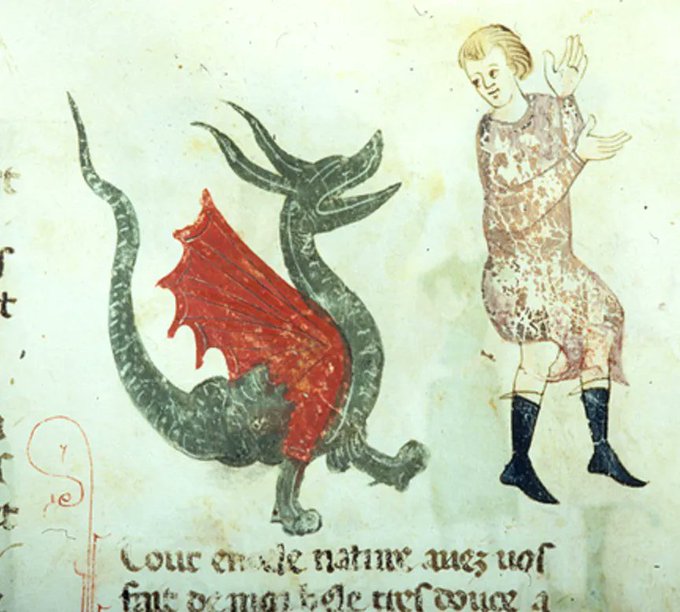
#OldEnglish #WOTD: folgian, wk.v: to follow. (FOL-yih-ahn / ˈfɔl-jɪ-an) Image: Bestiary; N Italy, c. 1290; @MorganLibrary MS M.459, f. 5r.

#OldEnglish #WOTD: scūr-boga, m.n: rainbow. (SHOOR-BO-gha / ˈʃuːr-ˌbɔ-xa) Image: Old English Hexateuch; England (Canterbury), 11th-12th century; @BLMedieval Cotton MS Claudius B IV, f. 16v.