
Dr. Oliver Demuthさんのイラストまとめ
@OliverDemuthFollow @OliverDemuthさんをフォローする
フォロー数:717 フォロワー数:2060


Additionally I wrote a script to quantify local shape disaprity in R. The script exploits the fact that the meshes are triangulated and thus allow the comparison of the normals of the faces and thus the vertices' (the 'landmarks') to find differences in their orientation 14/n

I also wrote a scripts in MEL (Maya Embedded Language) to visualize the quantified deformation, and also morph the surface approximation with the reconstruction in @AdskMaya. All code and data is available in the supplementary information: https://t.co/TNmxVuhFPD 13/n
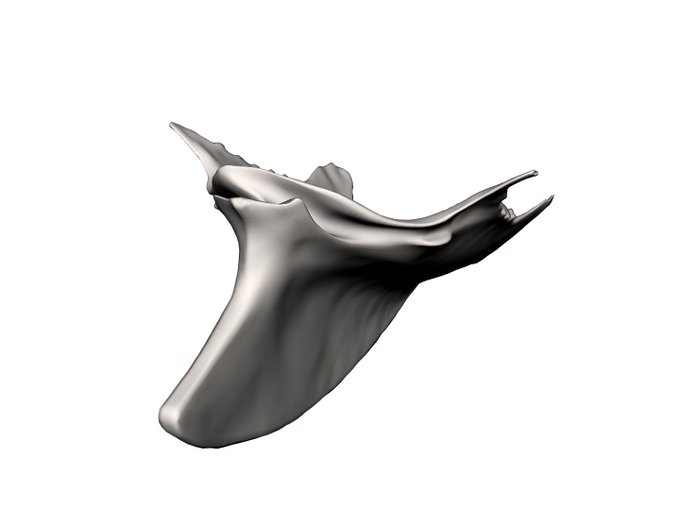
Ichthyornis has a peculiar sternum with highly crossed coracoid sulci. Skeletal asymmetry, while uncommon in vertebrates, it is challenging for retrodeformation. However, using our new workflow we were able to reconstruct the complete sternum including the asymmetrical parts 10/n
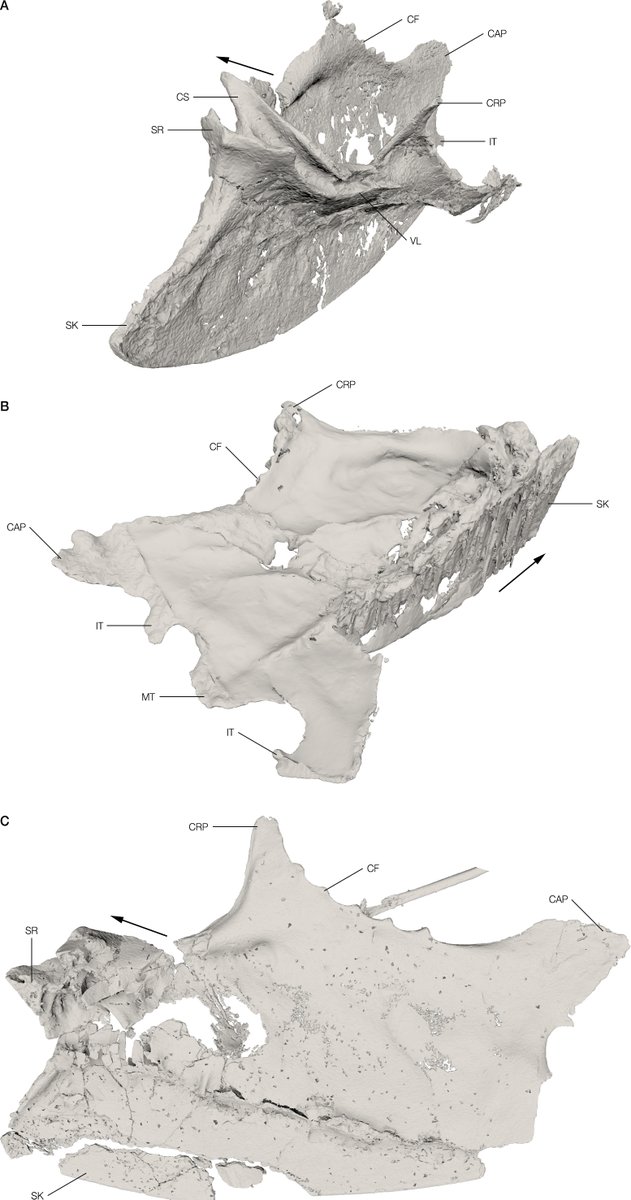
However, they do not include surface texture and minute shape variation on the surface (hence less precise). The low resolution also allows to easily combine multiple fragmentary specimens into a composite reconstruction and, more importantly, include asymmetrical components 9/n

This allowed us to build the full hindlimb musculature of Euparkeria capensis. A first for a Triassic fossils! All limb slices of the alligator can be found in the Supplementary Information here: https://t.co/NI1zU9Q9N3
7/n
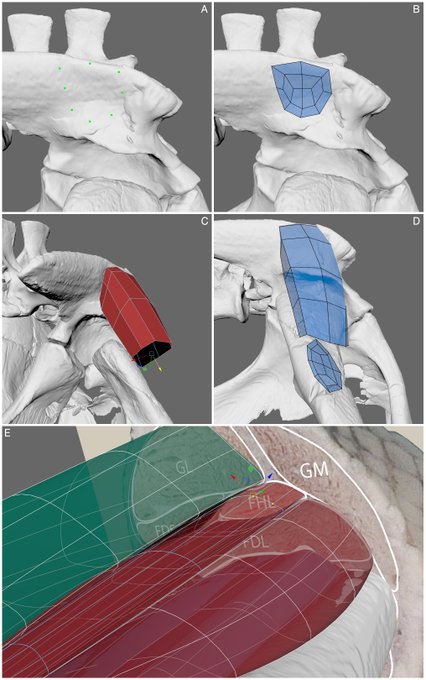
Using these cross-sections (in accordance with the extant phylogenetic bracket) and getting information on attachment sites from the bones themselves, we can recreate simplified volumetric muscles from origin to insertion in @AdskMaya using polygonal modelling techniques. 6/n
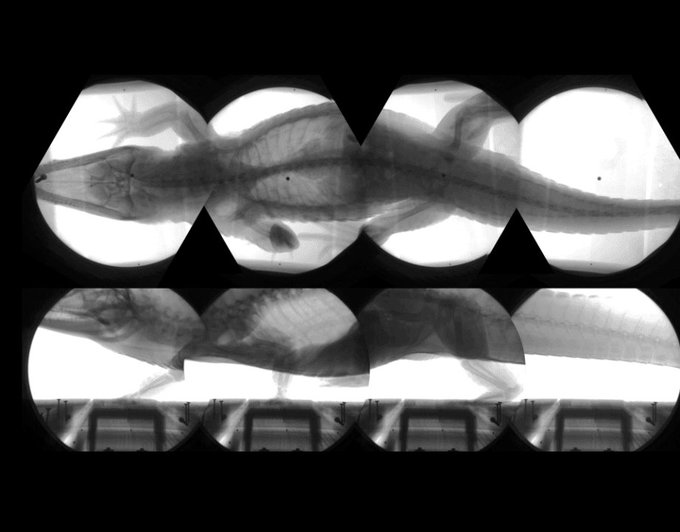
Hot off the press! New paper w/ Michelle Zwafing, @PalaeoStephan and @JohnNyakatura about the locomotion of #Orobates. Modelling muscle strain using MDA and evaluated it with Caiman data, including this idealized #XROMM walkcycle. The paper is #OpenAccess: https://t.co/8v8prJ3QUd

@Bhmllr @PashavanBijlert This is the 3D model of Victoria (with some internal soft tissues). There is some space between the pectoral girdle and the anterior most gastralia for the cartilaginous sternal plates. This is also where the cartilaginous sternal ribs would have attached to. I hope this helps :)
@PashavanBijlert @Bhmllr I agree. The scapulae of flightless birds are also somewhat more horizontal. This is how the pectoral girdle articulates on the Victoria 3D model. (Ignore the lunch on the right)

Patagotitan mayorum is one of the largest land animals that ever existed. 🦕 It is absolutely mind-boggling how ridiculously large it is. You can see their skeleton Máximo at the @FieldMuseum. Scale bar = 1 m. #HelloMáximo #PaleoArt #SciArt