Pre Cinema History 📷🎞️🇨🇦 🏴さんのイラストまとめ
@RealPreCinemaFollow @RealPreCinemaさんをフォローする
Author, researcher and compiler of THE HISTORY OF THE DISCOVERY OF CINEMATOGRAPHY.
I post daily here on X.
フォロー数:306 フォロワー数:2610


This print illustrates a private ‘Magic Lantern’ performance in an upper-class drawing-room, or salon operated by a projectionist and an organ-grinder. Called ‘The Magic Lantern’, from 1822. The family is gathered in the shadows. https://t.co/9Nwt4JaHcX

‘Le Singe qui Montre La Lanterne Magique’ is a comical steel engraving by Foulquier, after Victor Bachereau from 1865.
It’s one of the many book illustrations published on the well-known fable by Jean-Pierre Claris de Florian about a monkey displaying the ‘Magic Lantern’. https://t.co/SxBlZJdFsW
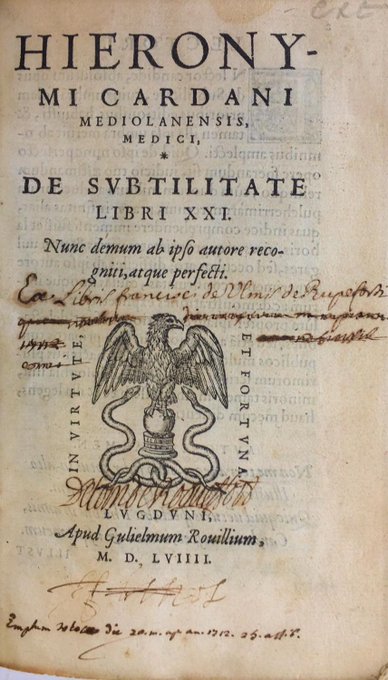

Cardano was a polymath, doctor & showman. He published in his book 'De Subtilitate Libri’, XXI, Cardani, Nurnberg, 1550.
Book IV, p107 describes his makings of a ‘Camera Obscura’ with a diverting spectacle and a graphic description of darkroom pictures and their appearances. https://t.co/q43NJOj0Eb


1811
OPTICS
DOMINIQUE-FRANÇOIS-JEAN ARAGO (1786-1853)
In 1811 Arago (l), in alliance w/ Augustin-Jean Fresnel (r), discovered that two beams of light polarized in vertical directions do not interfere, eventually resulting in the development of a transverse theory of light waves.
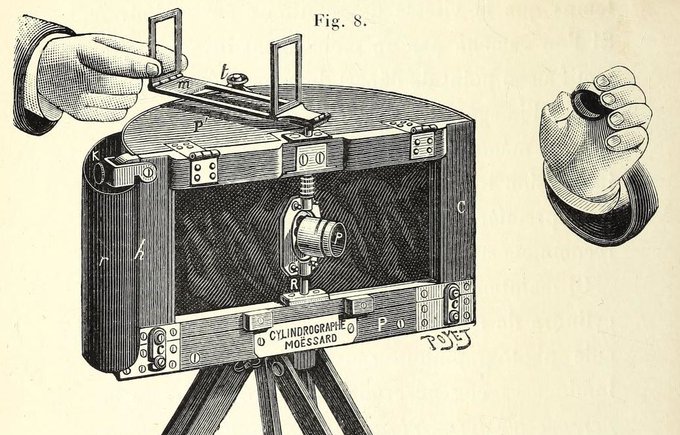

In 1884 Moëssard obtained a patent for a rotating-lens Panoramic camera. It covered a 170° field of view & was rotated by hand to expose the film.
Pictured is Moëssard’s 'Cylindrographe' illustration from ‘Le Cylindrographe Appareil Panoramique’, 1845, fig. 9, p23. https://t.co/syOmckkeLj

Folk woodcuts were shown in the ‘Kosmorama’, glued together in a long tape, rewound from roller to roller.
This ‘movement’ provided the idea of motion depending on what the viewer saw. -30- https://t.co/9sqo8vCotZ

1858
THE KOSMORAMA
The ‘Kosmorama’ is another name for a large square or rectangular shaped woodcut viewing device that can be viewed by several people at a time.
Another name for the Kosmorama is ‘Fotoplastykon’ (Polish) or ‘Photoplasticon’ (English).

EARLY SILENT MOVIE MAKE-UP
The developments in movie make-up in the early 20th century were on a scale similar to the changes that took place in 19th century stage make-up, after electric lighting was introduced into theatres.

OUTDOOR ROOM ‘CAMERA OBSCURA’
This illustration is taken from a 19th century book by Fulgence Marion entitled ‘The Wonders of Optics’ published in 1869. Here it is, made into a cute little coloured #animation.


1568
DANIEL BARBARO (1514-1570)
This Venetian nobleman and architect describes the use of a biconvex lens in the ‘Camera Obscura’ in his 'La Practtica Della Perspecttiva' (Barbaro, Venice, Italy, 1568, ch.5, p192) [below right].