NeandertalのTwitterイラスト検索結果。 2ページ目


Kebara 2: photo of the cast (by #JavierTrueba; left) and 3D virtual reconstruction of his thorax
#Neandertal #FossilFriday

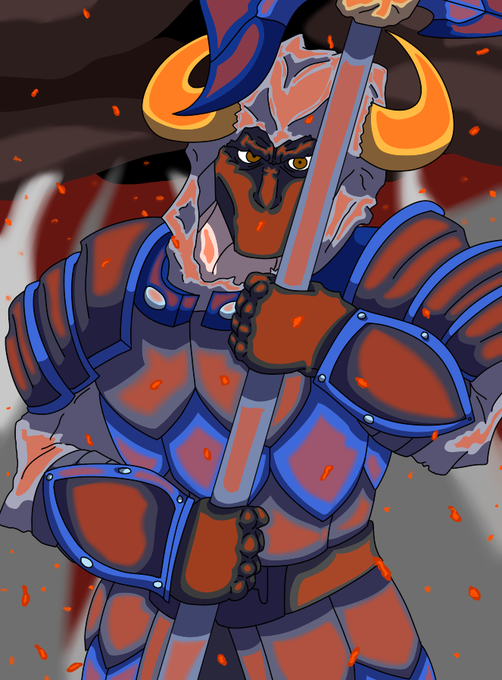
"IM the chosen of the dark gods, IM the chaos brringerr, And you, are just my next, VICTIM!!!"
Leader of the north, great jarl of the nordics, greater neandertaluss of the north, the great, Chosen one, the blessed, the cursed.
Manflesh


Más evidencias de que los neandertales tenían dieta variada, aunque con particularidades locales.
Dietary evidence from Central Asian Neanderthals: similar subsistence patterns to those elsewhere in their range - plants + large- & medium-sized ungulates https://t.co/TSEQna3KqZ

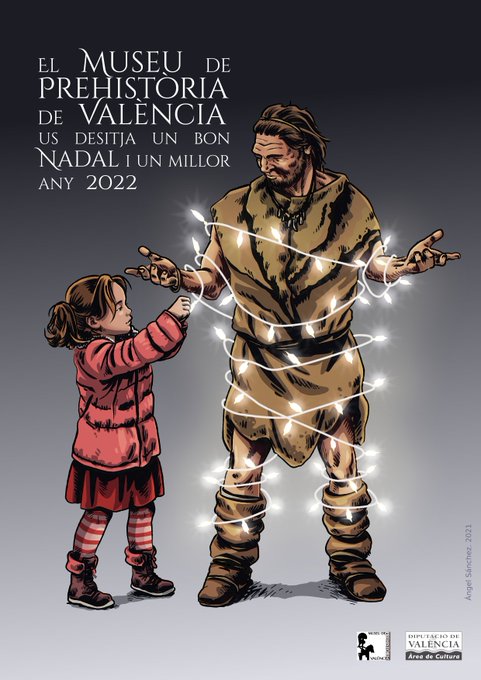
🦴 Com sabeu, recentment, les restes del #Neandertal de la #CovaForadada d'#Oliva tornaven a #Mupreva per al seu depòsit definitiu.
🤩 Una troballa extraordinària que ha inspirat la nostra felicitació d’enguany.
🎄 De tot cor, us desitgem un #BonNadal i un millor any 2022! 🥂


Paper: Landscape modification by Last Interglacial Neanderthals https://t.co/bUvFQUCciD
Summary: Neandertals were the first hominids to turn forest into grassland 125,000 years ago https://t.co/0UAa2TTqS7


For #FossilFriday, an ongoing work by Jiaming Hui on the diploic veins inside the bones of this Neandertal skull. Because we are not studying only #brains in @BrainPaleo !


PELA ALMA DE JESUS CRISTO! O JINN TA PARECENDO UM NEANDERTAL DAS CAVERNAS QUE NÃO TOMA BANHO DESDE QUE NASCEU! DEVE TÁ COM A MSM ROUPA TBM ESSE PALHAÇO! MASHIMA DESGRAÇADO!!!!!
MATARAM MEU FILHO! MATARAM MEU FILHO NA MINHA FRENTE E EU NÃO PUDE FAZER NADA PRA IMPEDIR!!!!!! https://t.co/BIEXbMh28S


Why avoid the obvious similarities between these fossils, especially the NR-2 mandible, and Neandertals, particularly Krapina? That relationship is the interesting one, with clear relevance to paleoclimate changes. Nesher Ramla may be a likely Krapina source population.

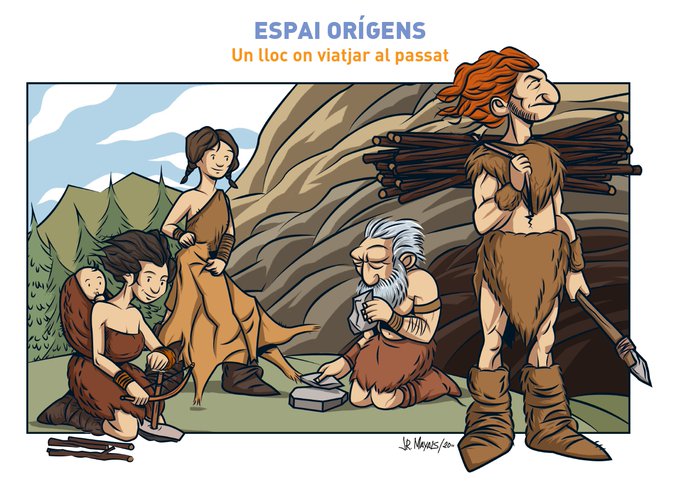
Aprendre sobre la vida quotidiana dels neandertals és possible gràcies a @espaiorigens. 🔎Explora el passat en família amb les activitats d’aquest centre i coneix els fascinants atractius turístics de la Noguera🌿 a https://t.co/baIaRvbwMu
#FemTerritorideValor #LeaderCAT2020

Krapina 4 is a fragmented skull of a Neandertal from around 120,000 years ago. This #hominin individual suffered a blunt force trauma to the left forehead, resulting in soft tissue infection of the area. Some healing happened prior to the individual's death. #paleaonthropology


@CrisR2021 Es posible que algunos neandertales tuvieran también pecas. Una cosa científica del ADN algo complicada de explicar.

Recent work by Yolanda Fernández-Jalvo and Peter Andrews found that cranial fractures on the Spy 1 Neandertal skull were the likely cause of death of this #hominin individual. A new dating scheme places the Spy Neandertals between 44,300 and 40,700 years ago. #paleoanthropology

Homo antecessor is a species that occupies a fascinating time and place in human origins. The #hominin material from Gran Dolina are the closest known sister group to the common ancestor of today's people, Neandertals, and Denisovans. #paleoanthropology

The fossils from Caune de l'Arago, France, are around the same age as the large Sima de los Huesos sample of early Neandertals. Whether they represent the same #hominin population is not clear. They test our ability to determine relationships with morphology. #paleoanthropology

Léon Henri-Martin found the humerus of a Neandertal partial skeleton in 1911 at La Quina. He wrote, "The fragility and powdery state of the upper right maxilla made three teeth fall into my hands." #hominin #paleoanthropology

The #hominin skeleton from Saint-Césaire, France is one of the last known Neandertals and lived some 42,000-40,000 years ago. The individual suffered but survived, at least for several weeks, a sharp force injury to the head. #paleoanthropology #FossilFriday

Arago 44 is almost certainly not H. erectus. It may be an early Neandertal or another (H. heidelbergensis?) species. OH 28 could possibly be H. erectus, but if so may be a most recent occurrence of the species in Africa. I suspect it's something else.

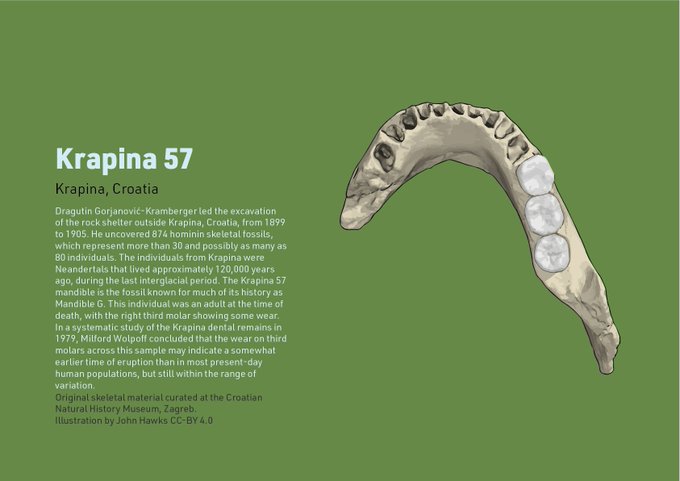
The Krapina Neandertal sample provides one of the most extensive dental records of any fossil #hominin population. Third molars may have erupted a bit earlier in this ancient group than in most people today, although within our extensive range of variability. @paleoanthropology
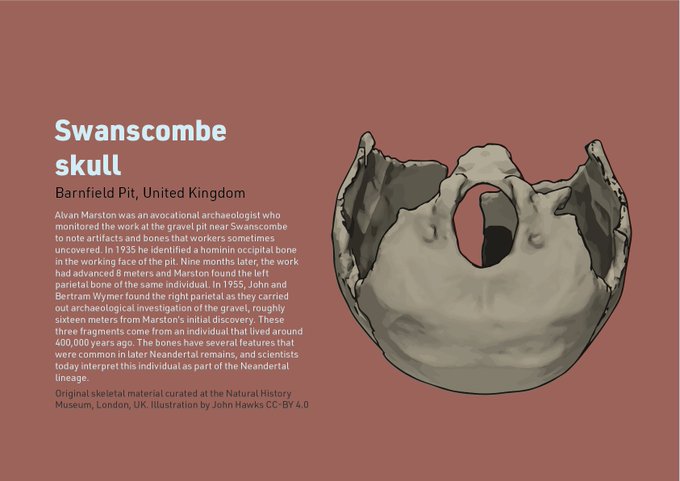
The three bones of the Swanscombe #hominin skull were found across 20 years within a gravel layer in the course of the ancient Thames River. The skull belonged to an early relative of Neandertals. #paleoanthropology #sciart