
The Klein Universeさんのイラストまとめ
@Klein_UniverseFollow @Klein_Universeさんをフォローする
フォロー数:294 フォロワー数:65865


The dark Horsehead Nebula and the glowing Orion Nebula are contrasting cosmic vistas. Adrift 1,500 light-years away in one of the night sky's most recognizable constellations, they appear in opposite corners of the this stunning mosaic [read more: https://t.co/hp6a0GlyvV]

What forms lurk in the mists of the Carina Nebula? The dark ominous figures are actually molecular clouds, knots of molecular gas and dust so thick they have become opaque. The image was captured by John Ebersole in 2016 from Siding Spring in Australia https://t.co/c9OkbaV3xa

Have you ever seen a dragon in the sky? Although real flying dragons don't exist, a huge dragon-shaped aurora developed in the sky over Iceland earlier this month and was captured by Jingyi Zhang & Wang Zheng https://t.co/p96l7kccvO
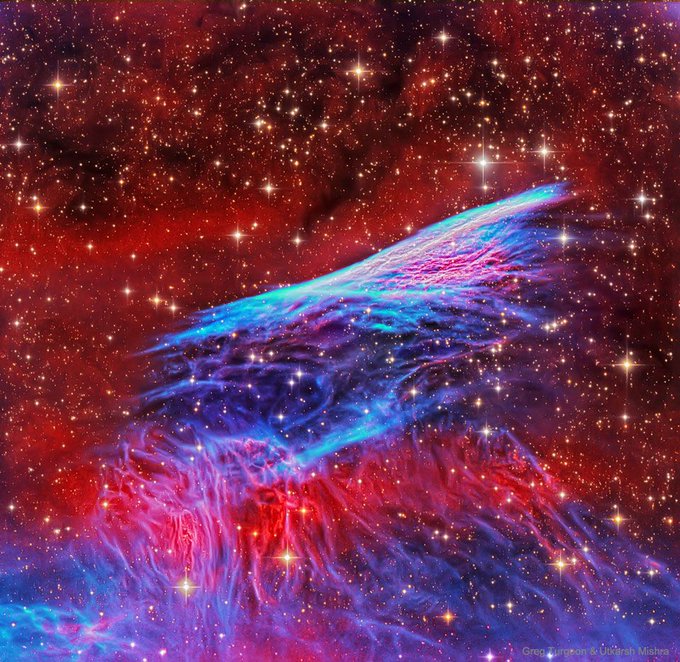
This supernova shock wave plows through interstellar space at over 500,000 km per hour. Near the middle and moving up in this sharply detailed color composite, thin, bright, braided filaments are actually long ripples in a cosmic sheet of glowing gas https://t.co/xaEJYUozO8

What lights up the Flame Nebula? Fifteen hundred light years away towards the constellation of Orion lies a nebula which, from its glow and dark dust lanes, appears, on the left, like a billowing fire https://t.co/2CU1ZEzeYQ

What's up in the sky from Auriga to Orion? Many of the famous stars and nebulas in this region were captured by Alistair Symon on 34 separate images, taking over 430 hours of exposure, and digitally combined to reveal the featured image https://t.co/8Xbm3VLllV

One of the brightest galaxies in planet Earth's sky is similar in size to our Milky Way Galaxy: big, beautiful Messier 81. Also known as Bode's galaxy for its 18th century discoverer, this grand spiral can be found toward the constellation of Ursa Major https://t.co/lH9xsTNa7R

The Pelican Nebula is changing. The entire nebula, officially designated IC 5070, is divided from the larger North America Nebula by a molecular cloud filled with dark dust [read more: https://t.co/6NqEpvHdZ9]

Do you recognize the constellation of Orion? It may be harder than usual in this image because the camera has zoomed in on the center, and the exposure is long enough to enhance nebulas beyond what the unaided human eye can see https://t.co/YFlvBiy9DT

In brush strokes of interstellar dust and glowing gas, this beautiful skyscape, composed over a decade with 400 hours of image data by J-P Metsavainio spans an impressive 28x18 degrees across the sky in the constellation Cygnus https://t.co/wVb53LDdP2