
The Klein Universeさんのイラストまとめ
@Klein_UniverseFollow @Klein_Universeさんをフォローする
フォロー数:294 フォロワー数:65865


Interstellar dust clouds and glowing nebulae abound in the fertile constellation of Orion. One of the brightest, M78, is centered in this colorful, wide field view by Wes Higgins, covering an area north of Orion's belt https://t.co/zcGOnrOIMi

Why does a cloudy moon sometimes appear colorful? The effect, called a lunar corona, is created by the quantum mechanical diffraction of light around individual, similarly-sized water droplets in an intervening but mostly-transparent cloud https://t.co/B94yTsbIeV

This fantastic skyscape lies near the edge of NGC 2174 a star forming region about 6,400 light-years away in the nebula-rich constellation of Orion. It follows mountainous clouds of gas and dust carved by winds and radiation from the region's newborn stars https://t.co/lu3vNBhuml
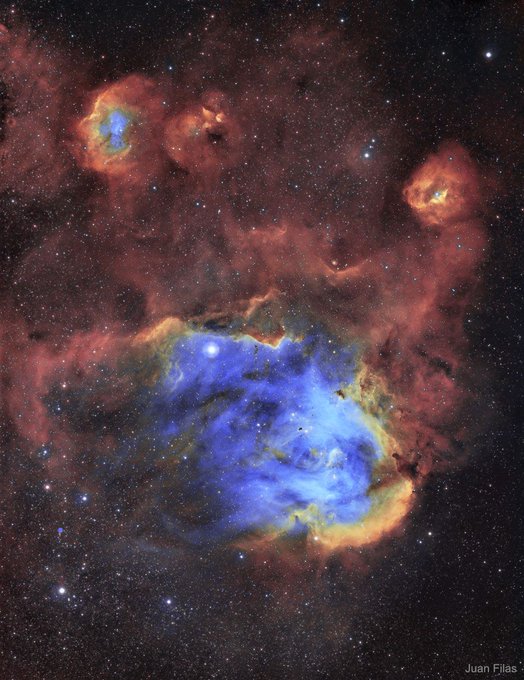
To some, it looks like a giant chicken running across the sky. To others, it looks like a gaseous nebula where star formation takes place. Cataloged as IC 2944, the Running Chicken Nebula spans about 100 light years and lies about 6,000 light years away https://t.co/rCamwLU7Xs

The center of the Milky Way glows in every type of light. In the featured image, high-energy X-ray emission captured by Chandra X-Ray Observatory appears in green and blue, while low-energy radio emission captured by MeerKAT telescope array is colored red https://t.co/nsWlrjKxUo

Found among the Small Magellanic Cloud's (SMC's) clusters and nebulas, NGC 346 is a star forming region about 200 light-years across, pictured here in the center of a Hubble Space Telescope image processed by @SpaceGeck https://t.co/4vCljGDdyq

How NASA's SOFIA -- an observatory flying in a modified 747 -- imaged the central region of the Milky Way with an instrument known as HAWC+ to visualize the magnetic field of our galaxy and this is the result https://t.co/p9TLtH1WJx
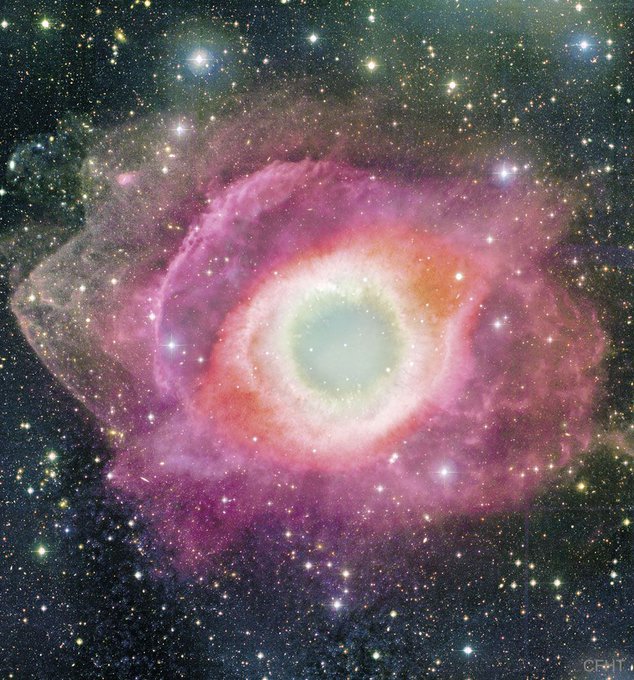
Will our Sun look like this one day? The Helix Nebula is one of brightest and closest examples of a planetary nebula, a gas cloud created at the end of the life of a Sun-like star [read more: https://t.co/rfmW4WfwKk]

Looping through the Jovian system in the late 1990s, the Galileo spacecraft recorded stunning views of Europa and uncovered evidence of a global ocean under its ice. Galileo's Europa image data has been remastered here, using improved new calibrations https://t.co/BReIOoz2sH

Do you see the bat? It haunts this cosmic close-up of the eastern Veil Nebula. The Veil Nebula itself is a large supernova remnant, the expanding debris cloud from the death explosion of a massive star https://t.co/cetUtH45mv