
The Klein Universeさんのイラストまとめ
@Klein_UniverseFollow @Klein_Universeさんをフォローする
フォロー数:294 フォロワー数:65865


Have you ever seen a dragon in the sky? Although real flying dragons don't exist, a huge dragon-shaped aurora developed in the sky over Iceland earlier this month and was captured by Jingyi Zhang & Wang Zheng https://t.co/p96l7kccvO

The Flame Nebula stands out in this optical image of the dusty, crowded star forming regions toward Orion's belt, a mere 1,400 light-years away. Click on the link and explore it by swiping the cursor https://t.co/FjvmwxXbeW

A ghostly visage on a cosmic scale, these remains of shocked, glowing gas haunt planet Earth's sky toward the constellation of Cygnus and form the Veil Nebula, a large supernova remnant, an expanding cloud born of the death explosion of a massive star https://t.co/PeemC9KRtx
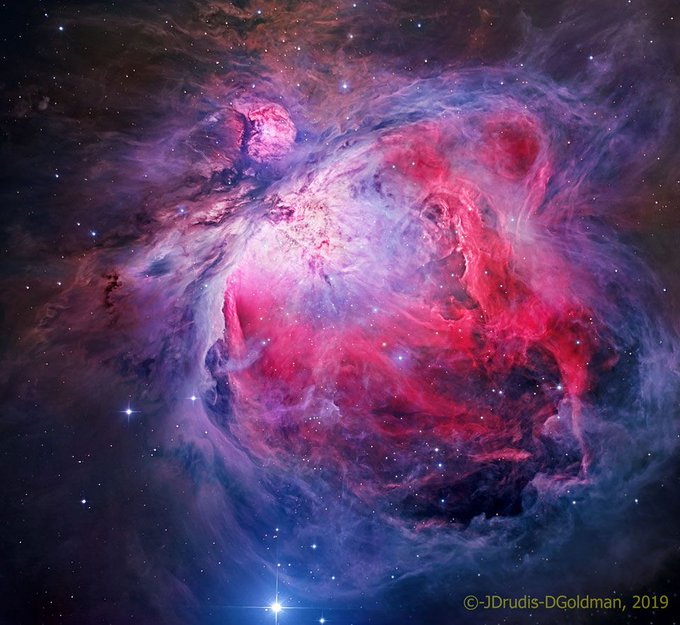
The Great Nebula in Orion, an immense, nearby starbirth region, is probably the most famous of all astronomical nebulas. Here, glowing gas surrounds hot young stars at the edge of an immense interstellar molecular cloud only 1500 light-years away https://t.co/9lSo0HaKXh
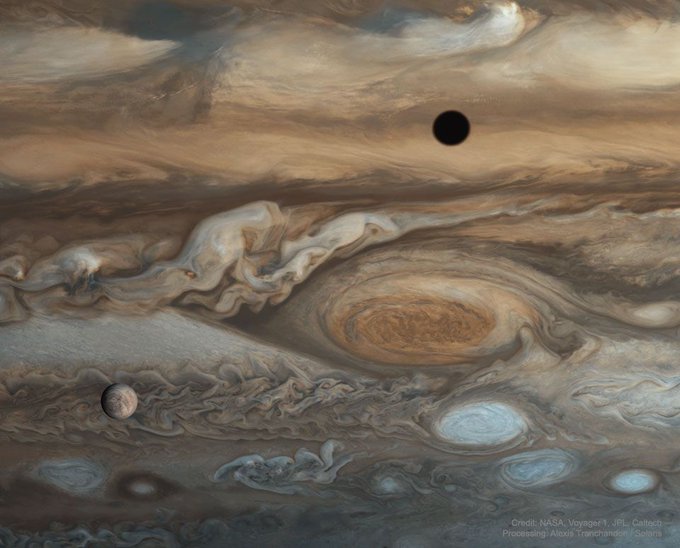
Largest and furthest, just right of center, is the Great Red Spot -- a huge storm system that has been raging on Jupiter possibly since Giovanni Cassini's likely notation of it 355 years ago. The spot on the left is one of Jupiter's largest moons: Europa https://t.co/Wq0U2mT5Ou

Analyses of observations by ESA's Planck satellite of emission by small magnetically-aligned dust grains reveal previously unknown magnetic field structures in our Milky Way Galaxy -- as shown by the curvy lines in this full-sky image https://t.co/u8EHpwirsf

Do you recognize the constellation of Orion? It may be harder than usual in this image because the camera has zoomed in on the center, and the exposure is long enough to enhance nebulas beyond what the unaided human eye can see https://t.co/YFlvBiy9DT

The large emission nebula dubbed IC 1805 looks, in whole, like a human heart. The nebula glows brightly in red light emitted by its most prominent element: hydrogen https://t.co/YlWWQD1w0o

Sharp telescopic views of NGC 3628 show a puffy galactic disk divided by dark dust lanes. Of course, this deep portrait of the magnificent, edge-on spiral galaxy puts some astronomers in mind of its popular moniker, the Hamburger Galaxy https://t.co/w0jYwepV7u

This stunning image of the star forming Orion Nebula was captured in 1901 by American astronomer and telescope designer George Ritchey. The original glass photographic plate has been digitized and light-to-dark inverted to produce a positive image https://t.co/3Upb7Ffnfv