
The Klein Universeさんのイラストまとめ
@Klein_UniverseFollow @Klein_Universeさんをフォローする
フォロー数:294 フォロワー数:65865

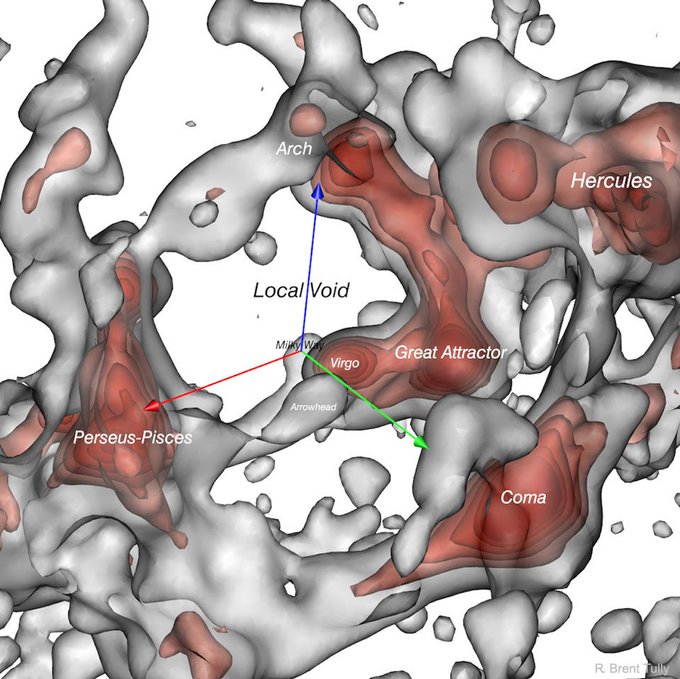
This map, spanning over 600 million light years on a side, shows that our Milky Way Galaxy is on the edge of the Virgo Cluster of Galaxies, which is connected to the Great Attractor -- an even larger grouping of galaxies https://t.co/VOczGkqpfj

To some, it looks like a giant chicken running across the sky. To others, it looks like a gaseous nebula where star formation takes place. Cataloged as IC 2944, the Running Chicken Nebula spans about 100 light years and lies about 6,000 light years away https://t.co/rCamwLU7Xs

It was just another day on aerosol Earth. For August 23, 2018, the identification and distribution of aerosols in the Earth's atmosphere is shown in this dramatic, planet-wide digital visualization https://t.co/dhDBdh3szj
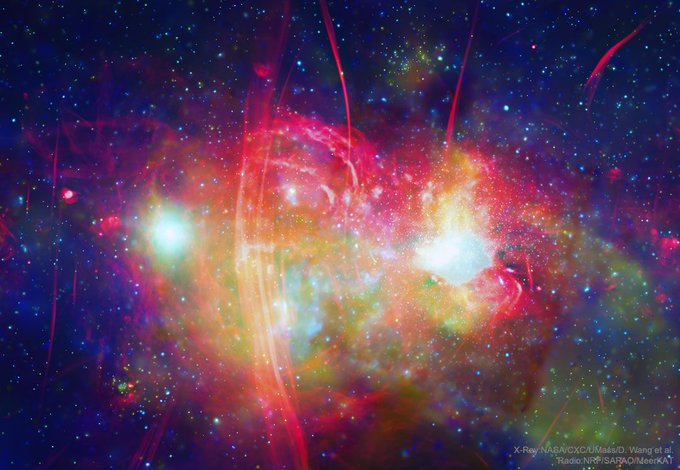
The center of the Milky Way glows in every type of light. In the featured image, high-energy X-ray emission captured by Chandra X-Ray Observatory appears in green and blue, while low-energy radio emission captured by MeerKAT telescope array is colored red https://t.co/nsWlrjKxUo
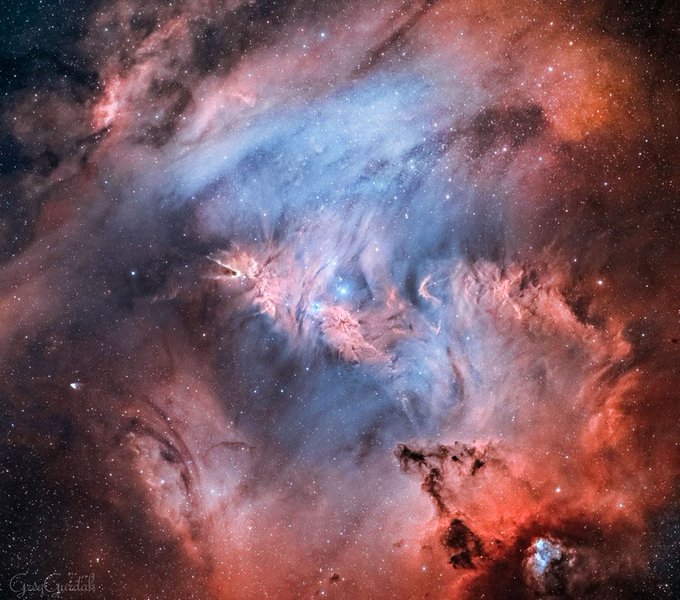
Pictured as a star forming region and cataloged as NGC 2264, the complex jumble of cosmic gas and dust is about 2,700 light-years distant and mixes reddish emission nebulae excited by energetic light from newborn stars with dark interstellar dust clouds https://t.co/OsTxHvLdyx

How NASA's SOFIA -- an observatory flying in a modified 747 -- imaged the central region of the Milky Way with an instrument known as HAWC+ to visualize the magnetic field of our galaxy and this is the result https://t.co/p9TLtH1WJx

This intriguing infographic includes relative sizes of the goldilocks zones for yellow G stars like the Sun, along with orange K dwarf stars and red M dwarf stars, both cooler and fainter than the Sun. M stars (top) have small, close-in Goldilocks zones https://t.co/afzmSpsliH

Do you see the bat? It haunts this cosmic close-up of the eastern Veil Nebula. The Veil Nebula itself is a large supernova remnant, the expanding debris cloud from the death explosion of a massive star https://t.co/cetUtH45mv

What's happening to these spiral galaxies? Although details remain uncertain, there sure seems to be a titanic battle going on. The upper galaxy is labelled UGC 1810 by itself, but together with its collisional partners is known as Arp 273 https://t.co/IZdk7nvND8

Have you ever seen a dragon in the sky? Although real flying dragons don't exist, a huge dragon-shaped aurora developed in the sky over Iceland earlier this month and was captured by Jingyi Zhang & Wang Zheng https://t.co/p96l7kccvO