
NASAさんのイラストまとめ
@NASAFollow @NASAさんをフォローする
フォロー数:119 フォロワー数:92109099


Teachers: Celebrate #PiDay in your classroom!
Challenge your students to use pi to solve some of the same problems our scientists and engineers face while exploring other worlds. Answer key is available on March 15. Slice into our #NASAPiDayChallenge: https://t.co/07d3us4Whh


Want to see a rocket launch? 🚀
If you live in or near the Mid-Atlantic region, you’re in luck— our #NG18 cargo mission is set to launch to the @Space_Station on Sunday, Nov. 6 at 5:30am ET (2130 UTC). With clear skies, you might see it. Viewing times: https://t.co/YSk0Wbmd7r

🗣 Applications for our Solar System Ambassadors Program close on Sept. 30. Through the program, selected space enthusiasts are trained, and volunteer to communicate our exciting discoveries to their communities. More on requirements, and how to apply: https://t.co/VxS6un0Iii

Search no more: the wonders of the cosmos, brought right to your screen. Today's @GoogleDoodles features the first full-color images from the world's most powerful space telescope, @NASAWebb. #UnfoldTheUniverse: https://t.co/0eYk8Q8oQB

💫 Known as the “Pillars of Creation,” these tendrils of cosmic dust and gas are giving birth to new stars, buried within their spires.
Celebrate #NebulaNovember with @NASAHubble and learn more about this beauty located in the Eagle Nebula: https://t.co/oXic9HMAw5

LIVE NOW: Scientists and experts detail how they expect @NASAWebb to #UnfoldTheUniverse when it looks back at the first stars and galaxies: https://t.co/z1RgZwyJyi

LIVE NOW: Our #DARTMission @Reddit Ask Me Anything is open for questions!
What do you want to know about our upcoming asteroid deflection test? Join us starting at 4pm ET (21:00 UTC) to talk with our planetary defense experts: https://t.co/X9shwUzfaq
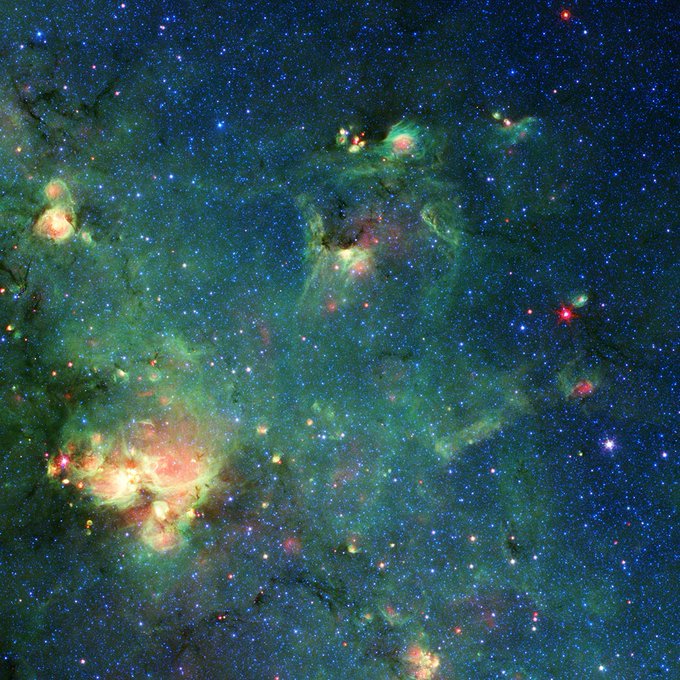
This Godzilla isn’t flattening any skylines — it’s just a cloud of gas and dust, striking an eerie resemblance to the fictional sea monster. In this image captured by our Spitzer Space Telescope, the colors represent different infrared light wavelengths: https://t.co/Q8jegKs0ZW

NEW: Scientists may have detected evidence of a planet candidate orbiting a star outside our Milky Way galaxy for the first time. The exoplanet could be about the size of Saturn: https://t.co/yoeFcGn2RK
Have questions? Head over to @ChandraXRay for a Q&A.